
Guide one · Medicare
Three enrollment paths, and the one you pick matters.
Counselors became eligible Medicare providers on January 1, 2024. Enrollment is not one decision but a choice between three arrangements with very different financial and administrative consequences. Switching later is possible and disruptive.
{{ p.name }}
{{ p.body }}
Suits: {{ p.suits }}

What enrollment involves
- {{ s.body }}
Facts worth knowing before you start
- {{ f.term }}
- {{ f.value }}
Verify current rates with CMS and with WPS Government Health Administrators, Michigan’s Medicare Administrative Contractor for Jurisdiction 8, before making a practice decision.
Guide two · Michigan Medicaid
Three ways in, and a routing rule that decides who pays.
Michigan Medicaid is not one payer. Which entity is responsible for a given client depends on their assessment scores, and that determines whether you can bill for them at all.
{{ p.name }}
{{ p.body }}
The routing rule, in one paragraph
Adults are assessed with LOCUS; children and young people with the MichiCANS Screener. When an adult scores 17 or above, or a young person reaches Level 2 or 3, responsibility for their mental health coverage shifts from their Medicaid Health Plan to a Prepaid Inpatient Health Plan. The code that signals this on the client’s CHAMPS record is BH-COVER.
The practical consequence for a private practice: if BH-COVER appears and you are not in that PIHP’s network, you cannot bill for that client, even though the clinical relationship is established and working. You need a PIHP contract or a Single Case Agreement. This is the problem MMHCA is actively advocating on.
Assessment billing codes
- {{ c.term }}
- {{ c.value }}
Per MDHHS bulletin MMP 26-01. Enrollment itself runs through CHAMPS, where counselors register as “Professional Counselor.”
Directory of all ten PIHP regionsGuide three · the monthly Q&A
Bring the question. It gets answered live.
The monthly Medicare and Private Practice Q&A is live, and deliberately unrecorded: counselors ask candid questions about real practices, and candor needs a closed door. Most problems a counselor brings have been solved in that room before, by someone who will say so out loud.
The sessions are led by Dr. Elizabeth Teklinski, who wrote the manual on incident-to billing and compliance, and attendees have previously received a free incident-to care plan template.
Subjects covered most often
{{ t }}
How this stays open
No paywall. That is deliberate, and it has a cost.
Everything on this page is published in the open. A counselor staring at a denied claim should not hit a login screen. What makes that possible is the members who pay dues anyway. The largest cost dues cover, by far, is professional lobbying representation in Lansing, the retainer that keeps a counselor’s voice in the rooms where the rules are written. The rest, the billing research behind these guides and the board members answering questions at ten at night, is working counselors serving without pay.
The arrangement is simple. If these guides have saved you an afternoon, a denied claim, or a call to a consultant, and you are not a member, joining is the fair exchange. Membership starts at $65 a year, and it is what keeps this page free for the counselor who finds it next. Members also get the live side of the work: the monthly consultation groups, the Medicare and Medicaid Q&A, direct answers from the board, and member and student rates on trainings and events. Zoom registration for the monthly sessions is open to members.
And whether or not you join this year, do the other thing that helps: send this page to a counselor who needs it. Every share puts the work in front of someone who would otherwise pay for it in time.
Guide four · why the status matters
What a 501(c)(6) can do that a charity cannot.
MMHCA is a 501(c)(6) trade association, not a 501(c)(3) charity. Counselors often assume that is a technicality. It is the reason the association can do the work described on this site.
{{ c.title }}
{{ c.body }}
Dues are not deductible as charitable contributions. They may be deductible as an ordinary and necessary business expense. Confirm your own position with your accountant. MMHCA cannot give tax advice.
Questions
If something here does not answer your question, email a person.
Everything on this page is open; there is nothing to sign in to here. The only sign-in the association uses is its membership system, for dues, receipts and event registration, and no password is ever stored on this website. If a question is not answered here, email the board and a working counselor will answer it rather than send you to a form.
Decision tree
Two or three questions, and you have your path.
Answer each question and the tree takes you to the next one that matters, ending on the enrollment path you should file for. You can change any answer.
Before you start. Confirm your NPI is active and its taxonomy reflects mental health counseling. This is not a branch in the tree, it is a prerequisite for all three paths, and a wrong taxonomy is the most common reason an application stalls.
Question {{ qNum }} of up to three
{{ qText }}
{{ qHelp }}
Your path
{{ resultName }}
{{ resultBody }}
- {{ r.term }}
- {{ r.value }}
All three paths, for reference
{{ o.name }}
{{ o.form }}
The non-participating fee schedule and the limiting charge are set in statute as percentages of the participating amount. Confirm current figures with CMS and with WPS Government Health Administrators before setting fees.
Routing diagram
How a Medicaid client is routed, and whether you can bill.
Follow it left to right. The score is what decides who pays, and who pays is what decides whether your claim goes anywhere.
-
{{ s.n }}
{{ s.stage }}
{{ s.body }}
{{ b.tag }}
{{ b.title }}
{{ b.body }}
The MHP-to-PIHP coverage shift was delayed by MDHHS and no replacement date has been announced. The routing structure itself is confirmed. Verify current status with MDHHS before relying on it.
Pathway
Becoming an LPC in Michigan.
Six stages, with the fees and hour counts as MMHCA publishes them, and the April 2023 rule changes marked where they land. Fees and requirements change. Confirm with LARA before you act.
-
Stage {{ p.n }}
{{ p.title }}
{{ p.body }}
Changed April 2023. {{ p.rule }}
Fees, hour counts and exam details are from MMHCA’s Pathway to Counseling Licensure in Michigan. Rule citations are to the Michigan Administrative Code as effective April 26, 2023 (R 338.1751 to R 338.1781). Confirm current requirements with LARA before acting on any of it.
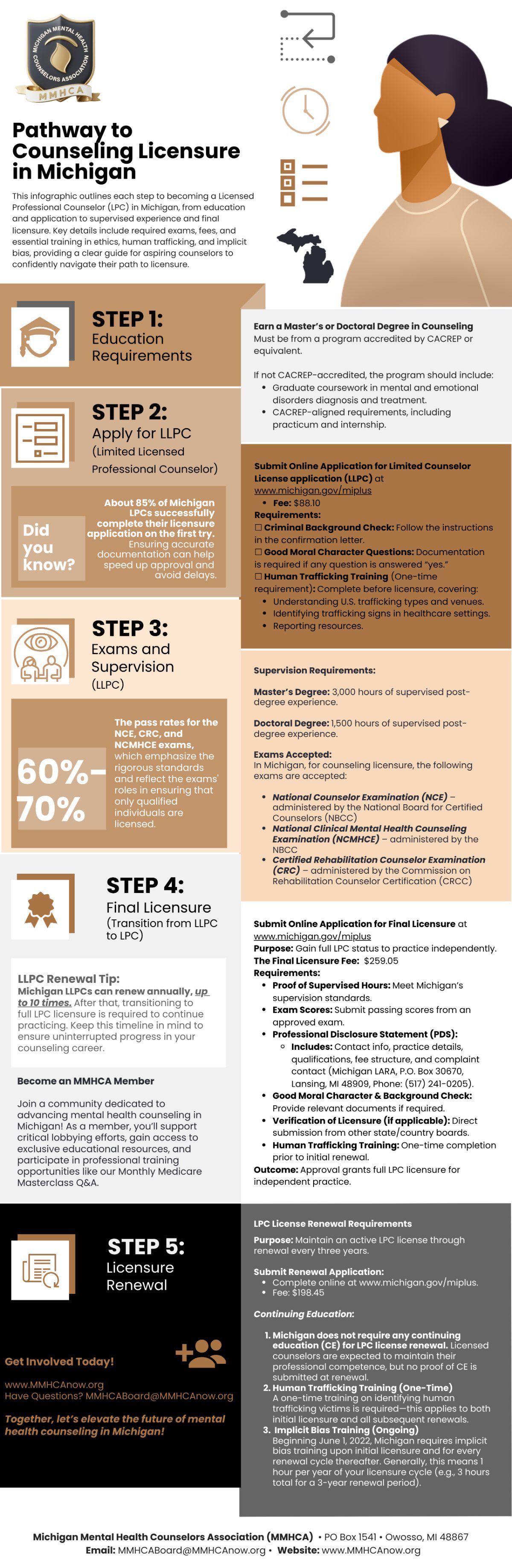
Open the image for full size.
One thing that helps
If you use this material, tell one colleague it exists.
Dues fund the lobbyist and the research, so the association’s reach in Lansing is a direct function of how many counselors are in it. Recommending MMHCA to one person this month is the most useful thing a member can do that costs nothing.
Continuing education · in development
Eight courses, built for the rules you actually work under.
Most continuing education is bought to satisfy a renewal, not to answer a question. This catalog is the other way around.
Coming soon. None of these are open for registration yet. This is the catalog as planned, published early so members can see what is coming and tell us what is missing. Course one opens first, with member pricing.

-
No. {{ c.n }} · {{ c.tag }}
{{ c.title }}
{{ c.body }}
Want a seat when course one opens, or a course that is not on this list? Tell the board. The catalog is still being set.
Email the board