
Update, July 29, 2026. BCBSM has announced no delay. Phase 1 of the incident-to change takes effect on September 1, 2026, 34 days from this update. Separately, the MDHHS Medicaid coverage-responsibility change (MHP takeover of lower-acuity behavioral health, with BH-COVER routing of higher-acuity cases) is temporarily delayed. MDHHS posted that the changes previously scheduled for October 1, 2026 are on hold to allow more time for system-wide preparation, and has not announced a new date. The other elements of the Mental Health Framework (LOCUS, the MichiCANS Screener, MMP 26-01 billing codes, CHAMPS workflow) are unaffected and stay in force.
Correcting the record
Senate Bill 1106 is not an attack on the LLPC credential.
The bill’s title has alarmed a number of counselors. Read in full, it does the opposite of what the title suggests.
SB 1106 repeals an obsolete provision that predates 1991, under which a bachelor’s-level pathway once existed in Michigan counselor licensure. That pathway has not been available for decades. The language has simply stayed on the books.
Removing it is technical cleanup. It does not change the LLPC credential, the master’s degree requirement, supervision requirements, or scope of practice. MMHCA supports the bill.
If you have seen a post claiming otherwise, the useful thing you can do is link colleagues to the bill text rather than to the summary. Confirm the current version and status on the Michigan Legislature’s own record before relying on any account of it, including this one.
Status dashboard
Where things actually stand.
A quick read on each major regulatory area. Navy means stable, gold means changing, deep gold means it needs your attention now.
{{ d.title }}
{{ d.body }}
Download · PDF · 9 pages
Michigan LPC/LLPC Regulatory Update, printable edition
The full 2024–2026 regulatory guide as a designed PDF: LARA rules, fee schedule, Counseling Compact, Medicare billing and telehealth. Version 10, February 2026.
At a glance, late August 2026
Michigan LPCs in numbers

The guides · open to every counselor
Deeper guidance, published in the open.
The how-to walkthroughs, decision tools and Q&A archive are published openly, funded by member dues, so any Michigan counselor can use them the day they need them.
These guides are open because members fund them. If one saves you time or a denied claim, consider becoming one of them.
Operational risk
The biggest risk in each practice category.
Where the rules are tightening, by the kind of work you do.
{{ r.cat }}
{{ r.lead }} {{ r.body }}
Right now
If you do one thing this month.
Find the line that describes your practice.
{{ m.tag }}
{{ m.title }}
{{ m.body }}
What’s locked, what isn’t
Confirmed versus still evolving.
The Mental Health Framework rollout has both. Knowing which is which prevents wasted preparation.
Confirmed
- {{ c }}
Still evolving
- {{ e }}
The single most confusing concept
What is BH-COVER?
BH-COVER is the MDHHS Medicaid benefit-plan code that signals an enrollee’s mental health coverage has shifted from their Medicaid Health Plan (MHP) to a Prepaid Inpatient Health Plan (PIHP). When this code appears on a patient’s CHAMPS record, the PIHP becomes the responsible payer, not the MHP.
The October 1, 2026 rollout is temporarily delayed, and MDHHS has not set a new date.
What it means for you
If you treat Medicaid patients in private practice and a BH-COVER code appears on a patient’s record, you can no longer bill that patient’s MHP. You need a PIHP contract or a Single Case Agreement to keep treating them. Otherwise the patient may have to move to a CMHSP-affiliated provider.
Urgent: coalition action
BCBSM is eliminating incident-to billing for limited-license providers.
Blue Cross Blue Shield of Michigan has confirmed elimination of incident-to billing for limited-license behavioral health providers in private office settings, effective March 1, 2027, and has announced no delay. MMHCA, NASW-Michigan, the Michigan Psychological Association and AAMFT are leading the coalition opposing this policy.
{{ ph.when }}
{{ ph.body }}
August 21, 2026 · Detroit
We showed up at BCBSM headquarters.
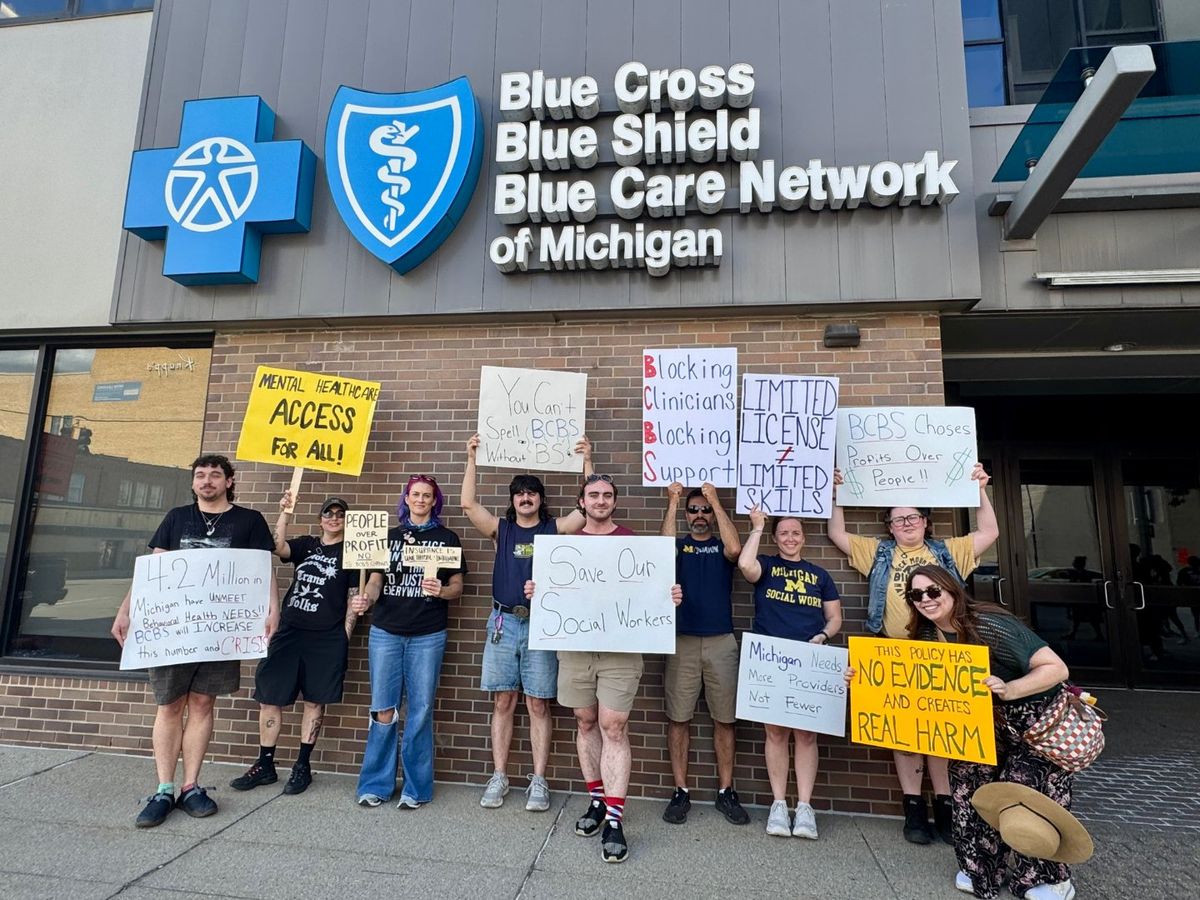
Counselors, social workers, clients and families stood outside 600 East Lafayette Boulevard with MMHCA, NASW Michigan and Healer’s Choice. Legislators spoke. BCBSM sent its interim chief medical officer to respond.
- When
- Friday, August 21, 2026
- Where
- BCBSM Headquarters, 600 East Lafayette Boulevard, Detroit
- Coverage
- CBS News Detroit and the Detroit Free Press
Take the impact survey
The surveys stay open to practice owners, fully licensed clinicians, limited licensed clinicians and clients. Aggregated results go to Michigan legislators and DIFS. Three short surveys, one per audience:
- {{ s }}
Published. The full statewide impact assessment is approved and live, with the findings, the downloadable report, the client handout and role-based letter templates. Read the impact assessment.
Other ways to act
- {{ a.lead }} {{ a.body }}
One place for everything
The Protect Private Practice hub
The coalition keeps every tool in one place, so you do not have to hunt for the right form or draft your own letter. Seven ways to act:
- {{ h }}
On the pavement
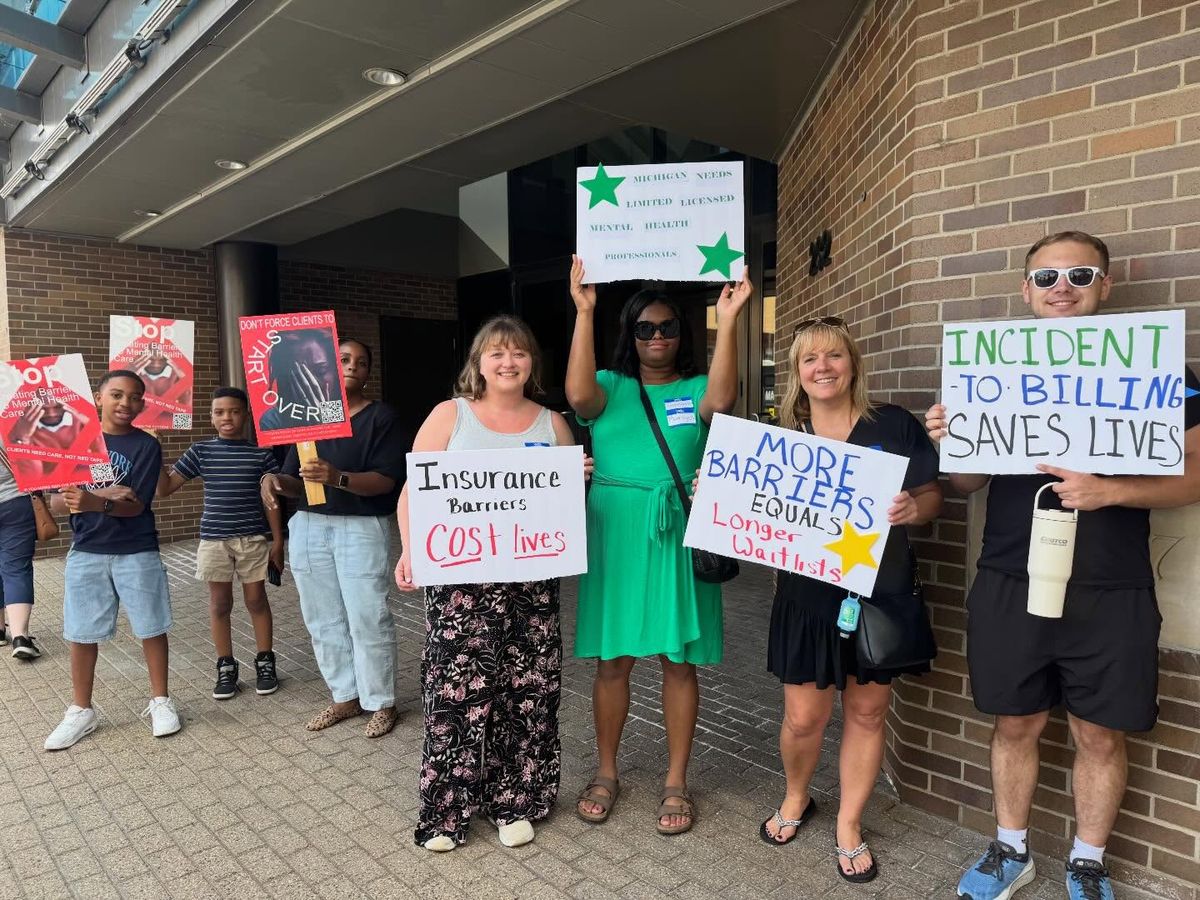
Counselors, clients and their families showed up.
Hand-lettered signs, children of clinicians, retired counselors, graduate students. Local television covered it. Every one of these people took a working day to stand outside an insurer’s building because a billing rule is about to close a door.
Photographs from coalition rallies at Blue Cross Blue Shield of Michigan facilities, summer 2026.
Rally and coalition activity
A joint coalition of MMHCA, NASW-Michigan, the Michigan Psychological Association and AAMFT, with legislative lobbyists and legal and clinical advocacy teams, is challenging the policy. The coalition held a rally at the BCBS Building, 232 S Capitol Ave, Lansing, on Tuesday, June 23, 2026, timed ahead of the legislature’s summer recess. A second community forum followed at Palmer Park, Detroit, in mid-July 2026, attended by Congresswoman Rashida Tlaib. The coalition then rallied at BCBSM headquarters in Detroit on Friday, August 21, 2026, where BCBSM sent its interim chief medical officer to respond. See what happened.
DIFS has not yet issued a statement, bulletin or action on the BCBSM incident-to policy, and no Michigan legislation specifically targeting it has been introduced.
BCBSM · Phase 1 · September 1, 2026
Modifier SA, and why looking it up makes it worse.
Search for modifier SA and every result describes a nurse practitioner working with a physician. That is the national definition, and it is not what is happening here. Blue Cross is reusing an existing modifier as a flag. Read the national definition and you will conclude this has nothing to do with you. It does.
What SA means nationally
“Nurse practitioner rendering service in collaboration with a physician.”
The HCPCS Level II definition. It is what Google, AAPC and your coding book will tell you, and it is correct as far as it goes.
What it means on a BCBSM claim
“This is an incident-to claim.”
Blue Cross is using SA to identify which claims are billed incident-to, so those claims can be separated from the rest. No nurse practitioner is involved.
You append it when all three are true.
If any one of them is false, the claim does not carry SA.
- A limited licensed clinician or trainee rendered the service.
- You are billing it under a supervising clinician’s credentials, that is, incident-to.
- The patient is a BCBSM or BCN commercial member.
One claim, before and after
Through August 31
90837
Billed under the supervising clinician. Eligible for value-based arrangements.
From September 1
90837‑SA
Same clinician, same NPI, same contracted rate. No longer eligible for value-based arrangements.
Worked through
Dr. Smith is your supervising clinician and the billing provider. Jamie, an LLPC, sees the patient and provides a 90837. You bill 90837-SA under Dr. Smith’s NPI, and Blue Cross pays Dr. Smith’s contracted rate. Nobody takes a rate cut in Phase 1. What that claim no longer earns is the value-based piece.
Nothing else about the claim moves. The rendering clinician stays in box 24J, the supervising clinician stays in box 31, the group NPI stays in box 33a. The only change is the modifier.
What you keep
- Your contracted rate. It does not drop in Phase 1.
- Your billing structure. The claim still goes out under the supervising clinician.
- Your supervision model.
- Payment. The claims are still payable.
What you lose
- Value-based reimbursement on those claims.
- PGIP incentive payments.
- Quality bonus eligibility.
- For some group practices, MMHCA estimates that is 5 to 15% of revenue on the affected claims.
What to do about it, in order.
The first four are August work. The fifth should already have started.
Flag who triggers it
List every limited licensed clinician and trainee on staff: LLPCs, LLMSWs, LLMFTs, TLLPs.
Configure the system
Most billing software can append a modifier automatically based on the rendering provider’s credential type. Set that rule rather than relying on memory.
Test before September 1
Run claims through your clearinghouse and confirm SA is actually transmitting. Find out in August, not in an October remittance.
Model what you lose
Pull your value-based and PGIP payments for the last year and work out which of them attach to claims that will carry SA.
Report on it
Split your reporting into SA-modified claims and everything else, so you can see the effect rather than guess at it. That report is also the evidence the coalition needs.
Credential your fully licensed clinicians
This is the long pole. Commercial credentialing runs three to six months, and Phase 2 is the deadline it has to beat. If a clinician is not individually credentialed with Blue Cross, you cannot bill under their NPI at all, which removes the main Phase 2 escape route.
Who this does not touch
Medicare Plus Blue. BCN Advantage. Michigan Medicaid, which is MDHHS and not Blue Cross at all.
If you hear that Blue Cross is ending incident-to for Medicare, that is not what is happening in Michigan. This is the commercial book of business.
Phase 2 is the one that hurts
SA is the soft landing. On March 1, 2027 limited licensed clinicians lose office-based incident-to altogether, and what incident-to remains is paid at 80% of the fee schedule.
Facility-based settings keep it. That is the whole substance of the disagreement, and it is why the impact assessment exists.
Three ways out, none of them small
- Move those caseloads to fully licensed clinicians.
- Become facility-based: hospital outpatient, a CMHSP, or outpatient psychiatric center qualification.
- Restructure how supervision works in the practice.
Modifier SA definition: HCPCS Level II. Phase dates, the SA requirement and the value-based exclusion: BCBSM provider communications, ereferrals.bcbsm.com and availity.com. Revenue range: MMHCA estimate from member practices, not a Blue Cross figure. This is educational, not billing advice. Confirm against the current BCBSM provider manual before you change how you bill.
Practice structure · looking at Phase 2
Integrated care, and what Michigan law leaves room for.
Integrating behavioral and physical health is where federal policy has been heading for years, and it is a direction MMHCA supports on the clinical merits. The question here is narrower and more practical: after March 1, 2027, which arrangements actually keep a Michigan counselor-owned practice billing. Several of the ones people reach for first do not, and it is worth knowing which before spending money on one.
Start here: the exception is about the setting
Blue Cross ends office-based incident-to for limited licensed clinicians. It leaves facility-based settings alone. Almost every failed workaround fails for the same reason: it adds a physician to the picture without changing what kind of setting you are.
Counts as facility-based
- Hospital outpatient departments
- Outpatient psychiatric centers
- Community Mental Health Service Programs
- Accredited behavioral health facilities
Does not
- Private practice offices
- Primary care clinics
- Co-located practices
- Group practices without facility accreditation
Five that do not work, and why.
The first four fail on setting. The fifth fails on ownership, which is a different problem with a harder edge.
Not a route
Co-location with a medical practice
The clinician works in the same building as a family practice and bills through it. This is still office-based incident-to. Physical proximity does not create facility status.
Real clinical benefit. Not a billing answer.
Not a route
Primary care behavioral health embedding
A behavioral health clinician embedded in a primary care practice, with warm handoffs and same-day access. Clinically this is one of the best models there is. It is also still incident-to, and a primary care office is not a behavioral health facility.
Not a route
Employment by the primary care practice
The physician practice employs the clinician directly. The employment relationship does not change the billing structure or the setting, and a family practice is not an outpatient psychiatric center.
Not a route
A referral agreement or memorandum of understanding
Valuable for care coordination and worth having on its own merits. It changes nothing about billing structure or facility status.
Not a route
A physician joins the counselor-owned practice as an owner
This is the one people reach for when the others fail, and it runs into a different wall: Michigan corporate law, not Blue Cross policy. A professional corporation may only have shareholders licensed to provide the service the corporation provides.
MCL 450.1284(1) for professional corporations and MCL 450.4904(2) for PLLCs say the same thing: where the service falls under the Public Health Code, every shareholder, member and manager must be licensed to render the same professional service.
Employing a psychiatrist does not get round it either.
The obvious next thought is to contract or employ rather than co-own. Michigan closes that too, and the statute is short enough to read yourself.
The same-license rule, in both statutes
“If a professional limited liability company renders a professional service that is included within the public health code … all members and managers of the company must be licensed or legally authorized in this state to render the same professional service.” MCL 450.4904(2).
The professional corporation act says the same thing at MCL 450.1284(1). Whichever form your practice takes, the rule is the same, and it decides what the entity may render, not merely who owns it. An LPC-owned entity is organized to render counseling. Practising medicine through it is not a staffing decision.
There is an exception. Counselors are not in it.
Michigan does permit some mixed-license professional entities. Subsections (3) and (4) of MCL 450.4904 name them:
- Chiropractic, part 164
- Medicine, part 170
- Osteopathic medicine and surgery, part 175
- Podiatric medicine and surgery, part 180
- Physician’s assistants, alongside the above
Counseling is part 181. It is not on the list, and neither are social work or marriage and family therapy. The legislature has opened this door before, most recently for chiropractors in 2023. It has not opened it for counselors.
What does exist, and why we are not going to walk you through it
There is a lawful way to put psychiatry alongside a counseling practice, and it is not one entity. It is two: a separate professional entity owned by the psychiatrist, and a management company that provides administration, billing and premises to it for a fair market fee. Health care lawyers build these regularly.
It is also the point at which anti-kickback, fee-splitting and referral rules start to apply, and where a structure that looks fine on a whiteboard becomes a problem in an audit. MMHCA is naming it so you know what to ask a health care attorney about. We are not going to describe how to assemble one, and nobody should build one from a web page.
Outpatient psychiatric care, in detail.
This is the only route on the page that keeps the practice independent, and it is the one most often described as simply hiring a psychiatrist. It is not that. Two separate Blue Cross documents are involved, and keeping them apart is what makes this defensible.
Two documents, not one
The incident-to policy
From March 1, 2027 limited licensed clinicians, temporary limited licensed psychologists, students and trainees are no longer reimbursable incident-to in professional office settings. Blue Cross says incident-to may continue in facility-based settings, naming hospitals and outpatient psychiatric centers among them. This document does not mention hiring a psychiatrist.
The OPC qualification standards
A separate and longstanding document, Clinical program requirements for behavioral health outpatient psychiatric care facility, revised March 13, 2026. This is where the psychiatrist requirement comes from, along with a good deal else.
The two are connected because Blue Cross has repeatedly pointed practices toward facility-based settings as where limited licensed clinicians may keep billing. They are not the same document and should not be quoted as though they were.
The staff Blue Cross requires
“A multidisciplinary staff for the provision of services which must include: a board-certified or board-eligible psychiatrist; a fully licensed psychologist or master’s level limited licensed psychologist … a licensed master’s social worker, or LMSW.”
Three required disciplines, not one. The same document lists licensed professional counselors and marriage and family therapists as staff a facility may also include. LPCs are permitted. They are not among the three that qualify the facility.
“Significant involvement by a psychiatrist in an OPC facility includes regularly scheduled hours in the facility, and availability for emergency consultation within two hours.”
Regularly scheduled hours on site, and a two-hour emergency consultation window. That is a materially different commitment from a remote oversight contract.
Everything else Blue Cross requires
- Organization as a legal entity.
- Full accreditation of each site, by address, for three or four years, by the Joint Commission, AOA, COA, CARF, NCQA, or an MDHHS certification letter for community mental health services.
- A comprehensive range of mental health services available to the community, which may include psychiatric evaluation and medication management, psychological testing, group and family therapy and crisis services.
- Emergency services available on a 24-hour basis through program staff.
- An organized patient record system meeting Blue Cross documentation requirements.
- Quality and care coordination responsibility resting with the named core leadership team.
- An on-site visit including review of a sample of medical records. The facility must be ready for it when the application is submitted.
- A separate application, and approval, for every location.
- Absence of inappropriate utilization patterns, tested through subscriber complaints, medical necessity audits, peer review and utilization management.
- Recredentialing every two to three years to verify continued compliance.
The timing trap
“The facility may not submit claims and isn’t eligible for reimbursement unless and until the facility’s application for participation is approved by Blue Cross and BCN. The effective date … will be the date the application is approved. It isn’t retroactive.”
Approval is not backdated to when you applied. Accreditation alone typically takes many months, and the on-site review has to be passable on the day you file. Against a March 1, 2027 date, a practice starting this now is not starting early.
What it costs
Psychiatrist arrangements run roughly $150 to $300 an hour depending on scope. That is a range members have reported to MMHCA, not a Blue Cross figure, and it covers only the psychiatrist. Accreditation, the psychologist and LMSW roles, 24-hour emergency cover and the records system are all separate.
Do the arithmetic before anything else. For a solo practice with twenty limited licensed hours a week this does not pencil out. For a group carrying a hundred, it might, and it still may not.
Where to start
- Read the standards yourself: Clinical program requirements for behavioral health outpatient psychiatric care facility, revised March 13, 2026.
- Ask Blue Cross, in writing, whether your specific practice and proposed staffing model would satisfy current participation requirements.
- Price accreditation first, not the psychiatrist. It is the long pole and the one nobody budgets for.
- Take the structure to a Michigan health care attorney before you sign anything.
MMHCA’s recommendation
Do not sign a psychiatrist employment or contractual agreement in reliance on this pathway until Blue Cross confirms in writing that your specific practice and proposed staffing model satisfy current participation requirements.
We have found no Blue Cross document stating that a counseling practice which hires a psychiatrist thereby qualifies as an OPC. What is published is a list of facility standards, of which psychiatrist staffing is one. The gap between those two things is where the money gets spent.
The question MMHCA has put to Blue Cross
Does Blue Cross consider an independently owned counseling practice that adds a psychiatrist to become an eligible OPC facility, or must additional operational, accreditation and facility requirements also be satisfied?
The published standards answer it one way. It matters that Blue Cross answers it in writing, because the pathway has been offered to practices in general terms and the standards are specific. Until then, treat “apply to become an OPC” as the beginning of a long process rather than a solution to a March 2027 deadline.
And a second question, for counsel rather than for Blue Cross: may a counselor-owned professional corporation or PLLC employ psychiatrists and provide physician services at all, without changing its ownership or organizational structure?
That one is Michigan corporate and professional entity law, not payer policy, and a willing payer does not settle it. Michigan health care counsel has reviewed MMHCA’s reading, that the same-license rule at MCL 450.1284(1) and MCL 450.4904(2) bars it, and confirmed it verbally; written confirmation has been requested and will be cited here when it arrives.
Affiliation: facility status, at the cost of independence.
Each of these is a real route for the caseload. Each also changes what the practice is.
Possible, at a price
FQHC affiliation or satellite site
Become a contracted provider or satellite site of a federally qualified health center. FQHCs are facility-based and exempt, and some are actively looking for behavioral health capacity.
You gain facility status, stable funding and loan repayment programs. You give up independence and take on sliding-fee and governance requirements.
Possible, at a price
Hospital outpatient department affiliation
Join a health system’s outpatient behavioral health structure and bill as hospital outpatient. Some systems are expanding behavioral health access and are open to it.
You gain facility status, often better rates and institutional support. You are now inside the system and subject to its policies, possibly as an employee.
Possible, at a price
CMHSP subcontract
Contract with your regional PIHP or CMHSP. This is mainly Medicaid rather than Blue Cross commercial, so treat it as revenue diversification rather than an exemption.
A steady referral source that offsets commercial losses. CMHSP rates and administrative requirements come with it.
A different structure: collaborative care
Stop trying to preserve incident-to. Bill something else.
In the collaborative care model a primary care practice, a behavioral health care manager and a consulting psychiatrist manage a caseload together, tracked in a registry and reviewed weekly. It is the best-evidenced integration model there is, and it has its own CPT codes, so it does not depend on incident-to at all.
The primary care practice
Bills the collaborative care codes, monthly, on time spent.
The counselor
Is the behavioral health care manager. Michigan’s CoCM training institute states the role may be held by any licensed professional with specialized mental health training, including limited licensed clinicians. MICMT FAQ
A psychiatrist
Consults weekly, usually remotely. No ownership question arises.
What it is not
- Collaborative care is built for screening and brief intervention on depression and anxiety, not ongoing intensive psychotherapy.
- Clients who need long-term therapy still have to be referred out.
- Bundled monthly payment will not necessarily match per-session therapy revenue.
- It requires real practice transformation: a registry, outcome measures such as the PHQ-9 and GAD-7, and integration with the primary care team.
- The medical practice is the billing entity. You are working inside someone else’s practice, not running your own.
Side by side.
The bottom line
No partnership creates the exception. Adding a physician to a private practice does not make it a facility, and adding one as an owner is closed to a counselor-owned practice under Michigan corporate law. What is left is genuine restructuring, a different billing model, or adapting the staffing. That is the shape of the problem, and it is why the association is arguing the policy rather than the paperwork.
What to do next
If you are exploring OPC qualification
- Request the current OPC-GI enrollment requirements from Blue Cross through Availity, in writing.
- Identify psychiatrist partners. Tele-psychiatry services offering oversight contracts exist.
- Model it honestly: psychiatrist cost against the limited licensed revenue you would preserve.
- Take the structure to a Michigan health care attorney before you sign anything.
If you are exploring collaborative care
- Find primary care practices already interested in behavioral health integration.
- Work through the AIMS Center implementation materials.
- Confirm collaborative care coverage on your own Blue Cross contracts.
- Budget for the practice transformation: registry, outcome tracking, weekly case review.
If you are adapting in place
- Credential every fully licensed clinician now. It is the three-to-six-month item.
- Model what shifting limited licensed caseloads does to your schedule and your revenue.
- Diversify the payer mix: Medicare, Medicaid, other commercial plans.
- Support your limited licensed clinicians through to full licensure.
Status of the legal position. Michigan health care counsel has reviewed the ownership analysis on this page and confirmed MMHCA’s reading verbally. Written confirmation has been requested and will be cited here when it arrives. The analysis rests on MCL 450.1284 for professional corporations and MCL 450.4904 for professional limited liability companies, which impose the same requirement, so the position does not turn on which form your practice takes. The OPC staffing and facility requirements are a separate question from the ownership one, and are quoted above from Blue Cross’s own published standards rather than inferred.
Prepared by MMHCA as an educational summary for members. It is not legal, tax or business advice and does not create a professional relationship. Blue Cross policies and accreditation requirements change. Before you restructure anything, get the current requirements from Blue Cross in writing and take advice from your own attorney and accountant.
MMHCA in action
The PIHP continuity-of-care problem.
When a Medicaid patient’s LOCUS scores 17 or above, or MichiCANS hits Level 2 or 3, their coverage shifts to a PIHP. Most private-practice LPCs cannot follow them. Here is why, and what MMHCA is doing about it.
Michigan’s PIHP and CMHSP system was built around organizational providers: community mental health agencies, residential facilities, hospitals. Not solo practitioners. There is no standardized statewide application for a private-practice LPC to join a PIHP network. Each of the ten PIHPs manages its own provider panel separately, and most contract primarily with organizations.
That means when a patient’s assessment routes them into BH-COVER, a private-practice LPC contracted with the patient’s MHP but not in the PIHP or CMHSP network may lose the billing pathway for that patient, even though the clinical relationship is established and working.
When the shift takes effect, this becomes routine rather than exceptional. A patient you have seen weekly for complex trauma could route to PIHP coverage you cannot bill against, without a contract you have no clear way to obtain.
What MMHCA is advocating for
- {{ a.text }}
Free guide · Updated September 10, 2026
The Mental Health Framework, start to finish.
LOCUS and MichiCANS step by step, the decision flowchart, the billing codes, how a private practice gets a PIHP contract, and the new Medicaid enrollment rules for limited licensed clinicians with the November 1 deadline. Open to everyone, no login.
Reference
Michigan’s ten PIHP regions.
Every Prepaid Inpatient Health Plan in the state, with the counties it covers, a phone number that works and a website that resolves. It lives on its own page so you can bookmark it and find it again.
Quick reference
Key resources and contacts.
Bookmark these. The full list lives in MMHCA’s monthly briefings.
{{ grp.name }}
{{ it.cat }}
{{ it.name }}
{{ it.url }}
{{ it.desc }}
MMHCA knowledge library
Still not sure? Start here.
These guides connect. What one cannot answer, the others usually can.